

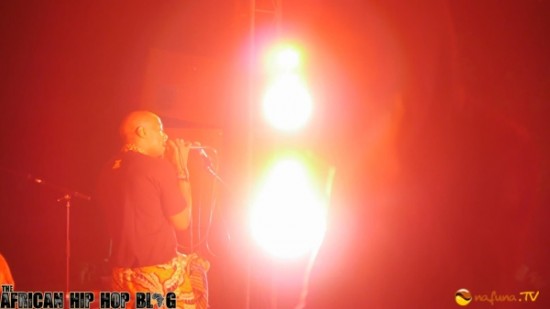
Khuli Chana performing his electric set at Shoko 2013
A week ago, I packed my bag with the essentials and left my small town bunker to head over to Harare to attend the Shoko festival. For those that don’t know Shoko is Zimbabwe’s largest spoken word festival. Celebrating poetry, spoken word, comedy & Hip Hop. As I’m sure you can tell from the name of this blog; you know the reason I was attending. Due to the fact I have a day job & I live in a remote city I was only able to attend the last 3 days of the festival… but what an experience that was.
This is Shoko’s third year & the festival is growing rapidly. It has now moved from the old venue at Book Cafe Harare to Waterwhirld, though this new venue won’t be permanent as the premises has been bought by the family that birthed Paris Hilton. It’ll soon be demolished to make way for a 5 star hotel. The growth of the festival was evidenced by the line up. Boasting a roster of over 250 artists showcasing over 6 days. The organisation that runs Shoko ( The Magamba Network) advertise the event as not only a music festival but also a medium to encourage social change which is a touchy, albeit necessary subject to cover in Zimbabwe. I had the privilege of sitting in on a few workshops & discussions centred around social media, creativity & influencing positive change. All of these were conducted or moderated by artists from all over the world, from places as far flung as Germany & Canada. The one thing that struck me was the humility & genuine interest they displayed (a quality that was lacking in some local artists which I will speak about later).
The highlight of the festival was its Peace In The Hood concert held in Glen Norah (one of Harare’s high density suburbs). It did seem that Shoko & the artists involved were genuinely interested in spreading a positive message & willing to help anyone who listened than they were in taking your money, which I found commendable. In America, Hip Hop has become so bastardised as it seems artists & fans have forgotten why the genre and culture were conceived in the first place. It wasn’t to buy a luxury car or spend ridiculous amounts of money at Gentlemen’s clubs without thought. It was to connect with people. People that felt oppressed & disenfranchised. It came about to as a means to relate powerful stories & influence change through an artform, despite the powers that be were doing all they could to stifle their voices.
I was really impressed by how approachable international acts like Ewok & Ian Kamau were, both of them skilled & talented artists in their own right; who had incredible live sets but are also extremely affable. I sat down with the both of them & heard of how Ewok doubles as a part time teacher in South Africa & how Ian Kamau makes it a point to connect with his fans personally, as far as staying in their homes (I’m assuming he has a taser or something). The backdrop of having the event at WaterWhirld provided an interesting contrast. Here was this vibrant, rapidly growing festival with all the advertising banners & stage setups against a backdrop akin to a once bustling theme park now falling apart; starkly highlighting the effects of the years Zimbabwe spent in financial turmoil. Seeing the waterpark I would visit during my Harare trips as a child reduced to dilapidated water slides and pools of algae made my heart sink. I’m uncertain if this was a deliberate move by the organisers to help drive home the theme of their event or if this was the only suitable event available.

Ian Kamau at Shoko13
Onto the music – several African Hip Hop acts were expected to perform. Musicians from Mozambique, Tanzania, Malawi, South Africa & of course Zimbabwe were on the bill. The diversity & depth of the line up was impressive. Some artists I have never heard of, while others I was familiar with. Surprisingly some were from my own city who have walked into my office on several occasions & I had no idea they were performers. Shoko has built a strong network of perfomers & it shows the festival is providing a platform for young & unseasoned artists to perform in front of skilled veterans to be under tutelage through the free workshops they provide. That has to be applauded more than anything more so than the breathtaking performances that had me screaming like a fangirl.
Sadly its not all rainbows & skittles. There are a few negatives that I gleaned too. As a Zimbabwean who has been following the local scene for a while now I have noticed certain trends among some artists. Firstly Zimbabwean rappers need to start taking their craft more seriously. I am not saying in their entirety they are half-assing it, that is untrue. There are a few noticeable beams of light. Sadly for the most part, there were occasions I found myself cringing or turning away from the stage because I couldn’t handle what I was seeing. I caught most of the local Hip Hop shows on both the Julius Chinongo & Chiwoniso Maraire Main Stages. Frequently I would see artists flub their lyrics, deliver loose & clearly unrehearsed sets or force the DJ to cut or skip a song mid set because they were running out of time or were out of breath. Other performers seemed to forget this was a festival, not an open mic night & performed new songs nobody knew or had sets that had even the hardiest of festival attendees walking over to investigate whether or not the popcorn guy had anything more entertaining to offer. Others were under the impression the open bar in the artists tent an offer too good to pass up spending a generous portion of their sets taking on stage drink breaks. Hey, do whatever you need to do to get in your zone, but don’t let that process disturb your actual performance. As a fan, that angered me, if I was still drinking I probably would have let my frustrations known in a less diplomatic manner & blamed it on the alcohol. What was frustrating was that repeatedly international artists would take the stage & deliver amazing, clean & engaging sets. Does that not embarrass & enrage local artists? Are you not ashamed you got shown up in your own country? This is the equivalent of a neighbour walking into your home and eating your piece of chicken while your wife & kids watch.

Comrade Fatso (one of the organisers of Shoko )
On both Friday & Saturday I arrived at the venue early enough to witness all the sound checks & rehearsals. I can count on 1 of Mickey Mouse’s hands the number of local acts that performed the necessary yet tedious ritual & all of them had amazing sets that showed this. On Saturday, I witnessed Khuli Chana, fresh off a 3 am performance in Bloemfontein & a 5am flight, come in with his 5 man band including his own sound engineer; spend over an hour ensuring the product he offered his fans was befitting that of a 3 time SAMA award winner. Later that night I saw Khuli‘s manager pull his whole band off stage & threaten to cancel his performance altogether over an issue with their keyboard. His set was delayed by almost 3o minutes as the organisers rushed to address it. After his performance it was apparent why they drew such a hard line. Khuli has a set that he has invested many hours of rehearsal into. A product that doesn’t revolve solely around him running around on stage with a simple backing track. He wants his shows to be an experience in and of themselves. Why can’t Zimbabwean artists adopt the same attitude?
Obviously I am not saying you have to have Khuli‘s budget, but surely we can cultivate the commitment to excellence he & other acts have. Why are you happy with just an comprising of you on stage with a backing track you haven’t even bothered to strip the vocals from? Why are you happy with incompetence? While at the festival I had a discussion with an artist & he was discussing the success other Zimbabwean acts like Winky D & Jah Praiser were currently enjoying. They have the followings & financial success I am sure all local artists strive for, but why is it only them that are enjoying it? We got into a lengthy discussion about the viability of the market, how Hip Hop is received in Zimbabwe, the potential for growth & even the infamous North & South Samora divide. Hip Hop is still a small market in Zimbabwe but it is far from a young artform. I know artists that have been making music for almost 15 years. So why does Hip Hop flounder while Dancehall & Urban grooves flourish? Our conclusion – Hip Hop artists have a skewed view of success, they are poor marketers & they do not make music that the public can relate to.

The controversial trio known as MMT
Winky D is so successful because he forces you to listen to his music at least once & he knows his product is so good that once you get a taste he has a new fan. I know, every year for the past 4 years without fail Winkey D will tour. He will tour campuses, bars and festivals. He will do whatever is necessary to ensure the public knows about him & his music, he will force it down your throat , you will listen. Then, once you’ve listened, if you like what you hear, you will share it with your friends, you will request it on the radio & soon 1 fan has created 3 or more, & so the music spreads.
I don’t know of any Zim Hip Hop artists that have toured campuses, I don’t know of any Hip Hop artists that have done any kind of local tour in general (with the exception of the Urban Groove/Hip Hop crossover artists like Stunner & Maskiri) . Now I know the argument, “Hip Hop in Zim isn’t popular enough to justify a tour”. My question to you is If you don’t go out there & force these potential fans to listen & buy into you as an artist who will? Not me. Nobody knew they liked Coca-Cola until they tried it.
Go and watch or read about how the Hip Hop movement that started in the Bronx. DJ Kool Herc drove around with those tower speakers blaring so he would force people to hear the music & get interested in the movement. Afrika Bambaata went out & organised parties to spread the word & culture, leading to other boroughs hearing about the movement & latching on. Artists from New York then hopped in vans, buses & whatever else they could find to spread to perform & spread the movement. Most of them got booed off stage but they persevered. Because of them Hip Hop has gone global & reached our nation though somehow we can’t do something within our own borders merely being mediocre. How do you perfect your product & live performance if you don’t hone your skills. All these small shows will eventually get you a shot at a large festival like clockwork.
Tehn Diamond performing during Jnr Brown’s set
Local Hip Hop also needs to become more relatable. Now I will stop myself short & say this trend is already happening. A decade ago I remember hearing local Hip Hop & it sounded like a cheap american rip off dubbed over with local accents. It was commonplace to hear an artist rapping about big rims, questionable women & popping bottles, while he caught a kombi to work & recorded the song in his friend’s garage. Since then the music has matured a great deal. Artists have realised the importance of making relatable music & speaking about their experiences , not those of the artists they wish to emulate. If you are making relatable music that appeals to the masses how do you know your music is not viable if nobody has actually made a concerted effort to reach the fans? I go back to Stunner because he is the closest example we have to this model. He sells out shows in what some might term the non Hip Hop demographic. Why are artists so afraid to test these new waters?
Finally, Zimbabwean artists need to set the bar for themselves higher. Having 1,000 YouTube views does not mean you have made it. A few thousands downloads on Hulkshare does not mean you are a star. People might be willing to listen to what you offer when its free. Will they be willing to pay to listen if you charge? As a culture we need to develop that hunger for more, bigger & greater things. We need to stop bickering amongst ourselves & start competing with fellow artists on our continent & across the globe.
So to go back to my title, Shoko told me this…Hip Hop in Zimbabwe has come so far. But still has a lot more to go.
