Guest Post: The Sad Case Of Lesotho Hip Hop
We came across this post by Sekese Rasephei on Lesotho hip -hop and thought it’d add weight to our exploration of African hip-hop as a whole. Sekese raps as Futuristic, and we’ve featured his crew Olive Branch here. Feel free to alert us to more cutting-edge writing about African hip-hop by contacting us here.
I have lost count of the number of times I went back and forth in my mind about writing the following analysis on Lesotho hip-hop. Granted it’s been something I have wanted to do for quite some time, yet never felt compelled enought. Alas, one can only flirt with an idea for so long! This is my earnest attempt at giving Lesotho hip-hop some form of back-story on Lesotho’s hip hop scene from a neutral, non-affiliated perspective. I hope to get some form of traction in diagnosing the current state of Lesotho hip-hop.
I am Sekese Rasephei, rap alias Futuristic. The first Lesotho hip-hop song I ever heard was Skebza’s ‘Dumelang’** circa early 2000s. At the time, I never fancied myself a rapper; I was an avid consumer of music in general. I only became aware of Lesotho hip-hop in the mid-2000s, courtesy of airplay on the country’s radio stations such as Joy FM and People’s Choice FM. However, right before I turned 15 in May 2006, Ultimate FM, the commercial wing of the national broadcaster, went on-air. It was the first time I heard Nuch (revered Lesotho-based emcee) on The Backdoor Sessions, a show on the radio station hosted by Mr. Maps. After hearing Nuch rap, I decided I wanted to rap. The Backdoor Sessions opened a can of worms when it came to local hip-hop for me; these were sweet, edible worms which I gladly gobbled down. I made a decision that I wanted to be a part of this world which I’d no idea existed – the world of Lesotho hip-hop.
There had been earlier movements and scenes which I wasn’t aware of. We had the Sprite-sponsored What’s Your Thirst? hip-hop show on PC-FM; the National University of Lesotho had the Africa Movement.
I love hip-hop. I love Lesotho hip-hop but unfortunately it is the most stagnant of hip-hop scenes I have ever come to know. There are more things wrong than there are right with it. The saddest thing is that we (everyone involved in the scene) are contributing immensely to its immobility. With the odds already stacked against us (no proper music industry in Lesotho, for one) one would think we’d be savvier in trying to build an industry conducive to our art, especially considering that we have raw talent in immeasurable amounts.
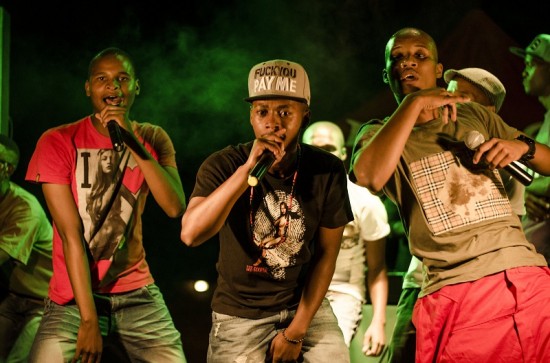
A collective called ‘The Lesotho All Stars’ performs live
My biggest gripe is that everybody wants to rap. I don’t know whether it’s a case of FOMO, or that people genuinely believe they are good rappers. A viable hip-hop industry is not built on rappers alone; I wish some people would direct the same amount of time, money and passion spent rapping at other essential elements required to have a fully-functioning industry.
An industry needs more serious radio presenters; serious promoters; serious record executives; serious video directors; serious photographers; serious writers. Essentially, less emcees who also happen to: produce, make beats, direct videos, makes album art, are promoters, managers, and everything else in-between. The problem with this set-up is that people don’t fulfill their roles effectively because there’s always a conflict of interest as a result of being committed to too many tasks. Hence, a situation arises whereby too many average-to-wack rappers saturate the scene – as is the case now – and ultimately giving it a bad reputation.
We are are a pretentious and disillusioned lot. We’d rather portray a life of having already made it (through our lyrical content) when reality is contrary to that notion. It’s almost as though we have totally dismissed the notion of creating a foundation on which to build from first. We are quick to want the rap life yet aren’t prepared to dedicate the endless hours required to manifest that dream, that life. It is why so many new rappers arrive year in and out. They jump onto the trend of that particular year, then quickly burn out because they were never interested in longevity to begin with (otherwise they would’ve put in the work).
Why haven’t we set up record companies that have proper A&R departments? Why don’t we have councils and syndicates that work towards establishing royalty collection agencies? These are not impossible ideas; we have the brains and the money to make all these possible. However, we are investing them in the wrong – or rather, unnecessary – aspects of the game.
We’ll always suffer because we’re not learning the basics of building an industry from countless others who’ve done it elsewhere in the world. This is how it has always been since my first exposure to Lesotho hip-hop 8 years ago, until now. Regardless of how much progress some may think has been made by hip-hop in Lesotho, the truth is we are stagnant and we have no one to blame except ourselves.
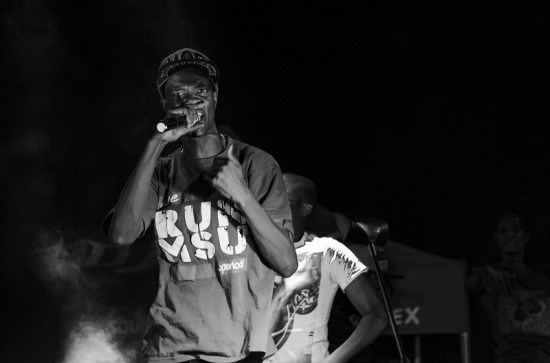
Skebza D, a long-time participant in Lesotho hip-hop
I always tell people that if Glory, Skebza, Nuch, L-Tore , Po’… hell, even Papa Zee never ate well off of rap then no one will. I say this because the aforementioned artists were/are the most talented, most commercially viable rappers to ever come out of Lesotho. According to me, they ought to have been being eating off of rap. This is not an unfounded pessimistic view of Lesotho Hip Hop but rather a realistic one. I have been in and around the game long enough. I use the word ‘industry’ in this entire piece very loosely because the industry is non-existent.
*Ed: emphasis on the D; Sesotho writes it as Lumelang. However, the song was originally written as Dumelang
**You can visit Sekese’s blog here
About Core Wreckah