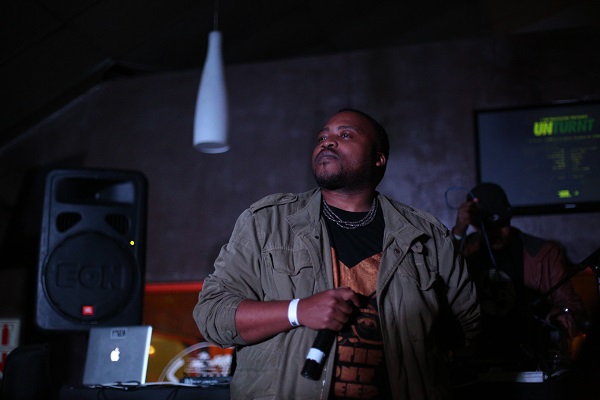
Tumi Molekane examining the crowd’s vibe.
Hip hop heads in Timbos and Jordans and baggy jeans that belong in the G-Unit era gathered at the Vodacom Village in Wynberg, Cape Town, for I AM Magazine’s Unturnt event last Saturday night. B-boys spun on their backs, honeys shook their posteriors on the dancefloor as deejays – DJ Codax, The Beat Bangaz (Azhul, Ready D and E-20) scratched and dished out some popular American hip hop tunes, a majority of them from the yesteryears. The Beat Bangaz gave an impressive show, showing off their polished scratching techniques and skill.
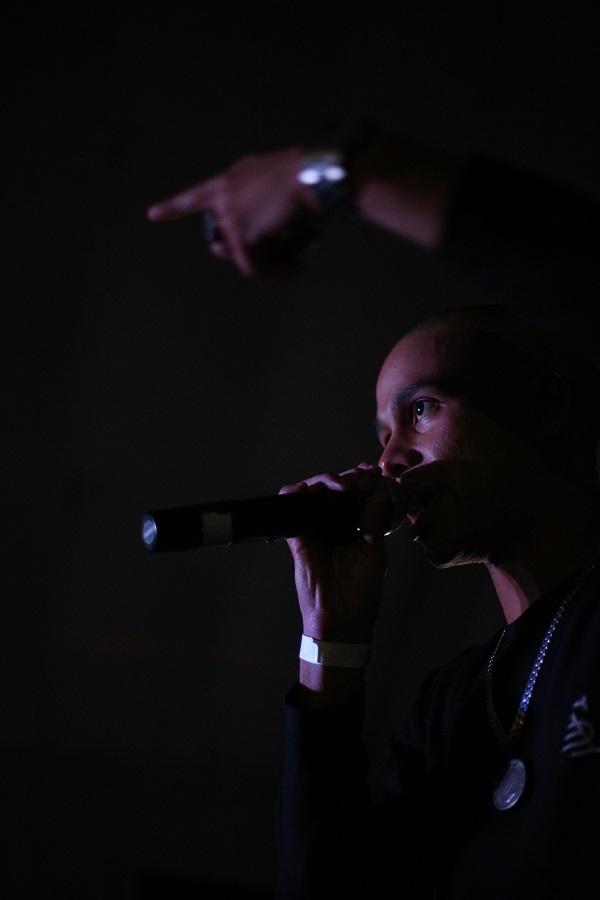
Youngsta owning it, as usual.
Several noteworthy names in the Cape Town hip hop scene were on the bill. Youngsta’s potency on the mic and home turf advantage saw him being the crowd’s favourite. Uno July, Cream, E-Jay, Claire Phillips all gave performances that were received well by the crowd. Andy Mkosi and Tumi Molekane gave great lyrical performances but were surprisingly not the crowd’s favourites – I guess one doesn’t simply spit poetic rhymes to a crowd of hyped up youths who had been turning up for hours in a club. Tumi had to cut his performance of the vicious “I’m Killing” and go with the crowd’s vibe with sing-along tunes like “Dats Wassup” and “In Defense of my Art”.
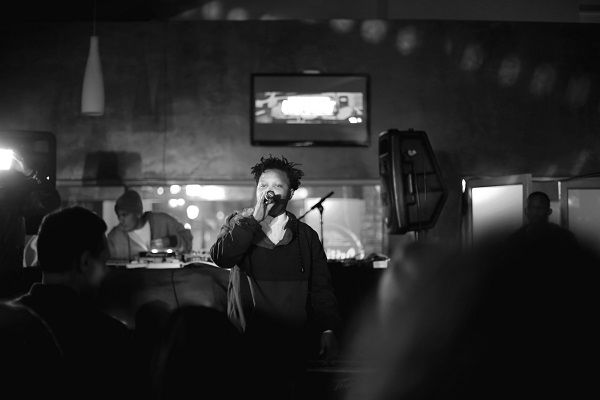
Andy Mkosi gave a laid back performance on the night.
The irony was that the event was called Unturnt – a concept Raisa Fisher, one of the organisers, described as an event celebrating artists who are being themselves and don’t conform to the ubiquitous turn up culture. The cold response to the two artists, who in my opinion were the most unturnt, especially a legend like Tumi made me doubt the crowd’s knowledge of South African hip hop, I dismissed a majority of them as just turn up cool kids. But crowd response aside, every performer gave it their best and I thoroughly enjoyed the whole show even though it started two hours late thanks to a power failure (no, not load shedding).
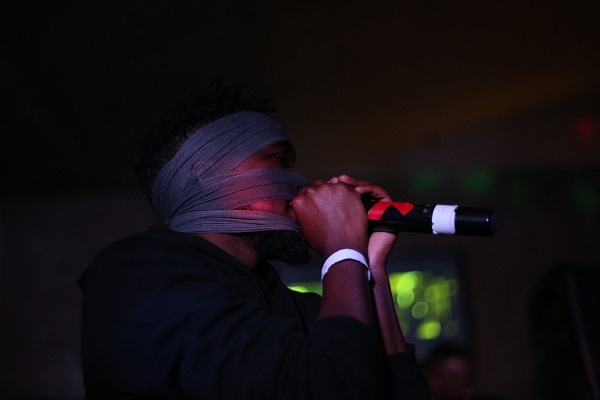
Uno July’s new sound seems to be working for him.
On the positive side, it was great to see a Cape Town hip hop event that had a diverse line-up with artists repping some of the various demographics of this overtly divided city, it’s a rarity that Cape Town hip hop has sadly grown comfortable with. Rapper E-Jay also brought his old crew-mate Tweezy who you might know for producing AKA’s massive hits, “Sim Dope”, “Run Jozi” and “All Eyes on Me”. The producer performed the last two joints at the event sending the crowd in a frenzy.
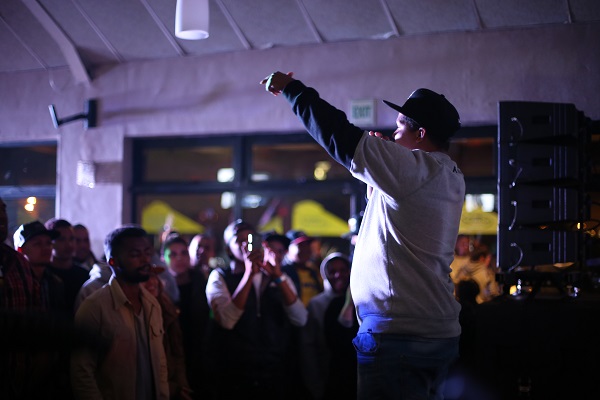
Cream’s intricate Afrikaans syllables coupled with Hipe’s banging production is always a winning formula.
I managed to catch up with Tumi a day later and asked him two questions about Cape Town hip hop.
There’s been talks that the industry is shutting Cape Town artists out. What are your general thoughts on the Cape Town scene?
Tumi: I don’t think anybody’s shutting anybody out. There was a time, obviously in the beginning, the days of Black Noise and POC [Prophets of da City] – the pioneers and then there was a really incredible time in the early 2000s, with Moodphase5ive, Godessa, Max Normal, where there was a movement. And like everywhere, people grow up, [to a point] where they are not part of the scene anymore. In Joburg, there was a time when we had poetry sessions but there comes a time when it’s like you are not 17 anymore, you are 23, and you are like either I do this or I do that, and either one can’t keep me in the movement, can’t keep me in the circle. I’m either gonna go to France and tour or I’m gonna go work in a bank and either one can’t keep me in the movement. I can’t be part of a so-called circle where we are nurturing each other because you know those are formative [stages]. Cape Town kinda had its phases. And I also feel the geography and geo-politics of Cape Town just don’t allow for a multi-cultural force, because where is it happening beyond the music? In Jo’burg, we interact with each other after-dark and in the day. In Cape Town, you don’t – Youngsta lives over there, Uno [July] lives over there. I chill with Youngsta and I have a very unique Capetonian experience, I chill with Uno and I have a very unique Capetonian experience, I chill with Ninja and I have a very unique Capetonian experience. Where do these [experiences] come together as just Cape Town hip hop? If Youngsta blows up, even though his music is distinctly Capetonian because he has the accent and it’s influenced by the street, it will just be Youngsta hip hop, not Cape Town hip hop. Just as when Die Antwoord blew up, it wasn’t ‘oh Cape Town is blowing up’, it was Die Antwoord. Same if Uno blows up, it won’t be Cape Town blowing up, it will be Uno blowing up. That said, I did [the Unturnt] event on Saturday, it was amazing to see [Ready] D, Youngsta, Uno, Claire Phillips, DJ Switch, all in one place. Now this feels like that thing where people are starting to understand [that] we have all our roles now, D can put Youngsta on, Youngsta can salute D. Uno can attract a different audience but still rock with Youngsta and it’s not that separated.
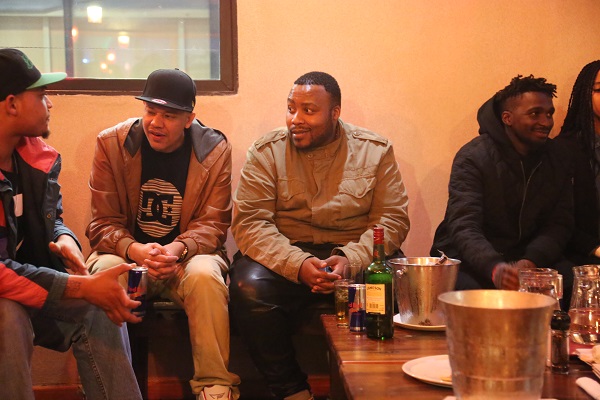
Tumi in the VIP section with P-Kuttah and Uno July.
And a vast number of artists will agree that Cape Town is a very difficult city to be relevant in. Do you agree?
Tumi: Yes. My experience with The Volume, we’d attract the student market because the music just happened to attract them and a lot of the tourists. But after the three years, it’s like the students you are cultivating move on and are gone and new ones come and you start over and the tourists are different. So it’s not a place where the people can grow with you. [With Jo’burg, however] the people who watched me at The Bassline 10 years ago, were watching me two weeks ago somewhere else. They’re all grown up and listen to Bach but they are like ‘I’ll still buy a Tumi record’. I’ve seen huge artists come here [Cape Town] and pulling nothing and I’m like ‘what just happened? How is that possible?’
The city itself still has a long way to go. Read a feature I did on segregation in Cape Town hip hop here.
Images by Sabelo Mkhabela and Andiswa Mkosi.