
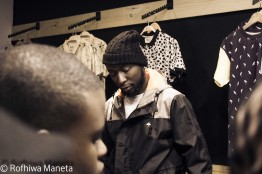
9th Wonder at the meet-and-greet sessions at Boaston Society.

9th spits jewels to the meet-and-greet audience.
The tour, which was headlined by 9th himself and rappers Rapsody and HaLo, involved a music conference which took place in Jo’burg. The Cape Town leg of the tour, which I got to experience last week, kicked off with a meet-and-greet session at concept store and project space Boaston Society on the city’s world-famous Long Street. Hosted by Cape Town emcee Andy Mkosi who is slowly becoming a notable name in The Mother City’s hip hop scene, the meet-and-greet took on the tired theme of “women in the entertainment industry”. Andy’s personal take on the issue was that being a female doesn’t [or at least shouldn’t] put one at an advantage or disadvantage in the entertainment industry. “You shouldn’t be a female presenter or a female rapper but simply just a presenter or rapper,” she said. Rapsody admitted that she used to embrace being addressed as a female emcee or “femcee” until she realised that it put her in a box. “People are always like: ‘Oh, you need to beef with Jean Grae, or throw some shots at Nicki. You’re the hottest female emcee’ but where do I stand with the rest of the emcees?” she said.

Emcee HaLo shares his story at The Assembly.
Luckily, the discussion diverted from the confining “women in the entertainment industry” theme. It veered, thanks to some pertinent questions from the audience, into interesting issues such as 9th Wonder’s hip hop academia work. 9th, who is a Havard Fellow, has been lecturing in university since 2006. He is a professor at Duke University and heads the Hip Hop Institute at North Carolina Central University – the same university where he met rappers Phonte and Big Pooh (members of Little Brother – a hip hop group he was once part of). “I’ve been at Havard for two years now, trying to institutionalise and put hip hop into an academic form so it can live forever and so we can study it the right way instead of the wrong way,” he told the attentive congregation of hip hop heads and likers of things.

Expanding on how hip hop lives in academia, he began: “Let’s face it: African people – people of this colour, we are genius people.” The audience applauded in self-appraisal before he continued: “We do things, we create things like it’s nothing to us. We marvel people by the things that we do. By nature. The problem is mainstream doesn’t show that greatness.” One of his main aims is, he explained, “to get academia to understand that. To translate that into an academic sense without saying ‘we are better than y’all’. To really put that in an academic sense and show the genius out of hip hop, which hasn’t been shown in a long time.” This changes the perception of outsiders from looking at hip hop as just a savage, misogynistic, and materialistic culture to having some form of reverence for the artform especially once they are made to learn about the meticulous process of creating the music.
“We start talking about sourced material. We look at an album like Jay Z’s The Blueprint, from the crates – all the records that were used – that is sourced material. If you put down all the credits – all the samples, all the instruments that were played, it’s a thesis. All the people that were involved in making this one record, that’s something that can be studied. And that’s just one album in hip hop. Just one. Imagine if we talk about 500 albums, that’s a whole lifetime of studying,” he said.
Another album that has been studied and discussed by a panel at the Duke University was Nas’ ’94 album Illmatic – which has, over the years, become a hip hop landmark. One soul in the meet-and-greet audience asked him what new school album he feels is worthy of being studied. “[Kendrick Lamar’s] Good Kid, M.A.A.d City,” he responded. “You gotta look at it and understand. That’s a concept album. We haven’t seen a concept album from a new artist in the mainstream in a very long time. Of course Kanye [West] has been doing concept albums since 2004. But Good Kid, M.A.A.d City, a concept album from a new kid that young, with skits – it told a story and it made it to the mainstream, that’s a milestone.”

Reason gave an astounding performance on the night.
The mainstream. “Why do you think mixtape-Drake will feature Phonte on a song but not on his album? Or Childish Gambino will spit a verse on a Rapsody mixtape but won’t show her the same love on his own album?” asked one audience member.
“When people get into the industry, they get afraid that they are gonna get knocked off,” 9th Wonder responded. “What happens if Drake puts Phonte on a song for the world to see? If the world finds out about Phonte, Drake [who has been accused of stealing Phonte’s style] has to explain.” Chuckles from the audience were followed by silence only interrupted by camera shatter sounds.
“People who listen to mainstream music live in a level of ignorance,” he continued. “They are living in the matrix, they just haven’t taken the red pill yet, they’re still walking around.”
In case you are living in the matrix; Drake, before he made the world believe that “you only live once”, made some music with 9th Wonder and his circle – which, at that time, included talented vocalist and emcee Phonte and a couple of others. You might want to familiarise yourself with Drake’s 2007 mixtape Comeback Season and thank me later (see what I did there?).
“The same goes for me; a lot of artists will put me on their mixtapes but when it comes to their albums, they won’t. But when we see them at airports, they know what’s up!” The Jamla boss is, however, under no pressure to make an 808s and bass club banger in this lifetime. His organic soul sample-heavy sound has given him the staying power he is still enjoying. “We don’t succumb to what the mainstream does anyway. We don’t give a fuck,” he said. “Radio is gonna play what it’s gonna play. The wave is gonna change every two years – there’ll be a new genre or new dance. Turn-up will be gone in about eight months. Before that it was snap, before [snap], it was crunk. If you go way back, it was disco. So we just have to concentrate on what the culture is, because it’s bigger than radio or TV. It can never be confined to those two mediums.”

He reassured us though that “the underground” is where the essence of hip hop culture still lived. “Make no mistake – I want you to take this home with you – they [mainstream artists] wanna be us. Deep down in their soul, they want to be us. They want to make the music [we make]. You have to understand where Drake started.”
The gathering which 9th Wonder ended by saying: “We don’t get this – many black folk gathered in one spot to see us – at home in North Carolina”, brought us closer to the artists. Anticipation for their show, which was to take place at The Assembly later that same evening, grew.

Rhapsody gave it her all
It’s easy to overlook what an accomplished emcee Rapsody is. She has traded bars with revered emcees – the likes of Common, Jean Grae, Childish Gambino, Big K.R.I.T, Mac Miller…hey the list is endless. And she has an impressive discography which she weaved through with a charismatic stage presence and audible voice-projection, backed by 9th himself on the decks, at The Assembly. HaLo failed to leave an impression on many of us. Especially since his set was preceded by a scorching performance by South African lyricist Reason who was announced as the opening act a few hours before the gig. He performed a list of his radio hits and made me realise how far the man has come. And it’s apt to predict he still has a long way to go.
DJ Zakes, who was on the line up, wasn’t there and no explanation was given. However, his absence wasn’t felt at all as Cape Town DJ, Ruthy Pearl kept the crowd warmed up before the live performances. The show was well-attended, the performances were great, the sound was crisp, and a lot of fun was had.
Meet-and-greet images by Rofhiwa Maneta
Gig images by Andiswa Mkosi
More images at the Boaston Society Facebook page.



Pingback: Stalking Reason - The African Hip Hop Blog()